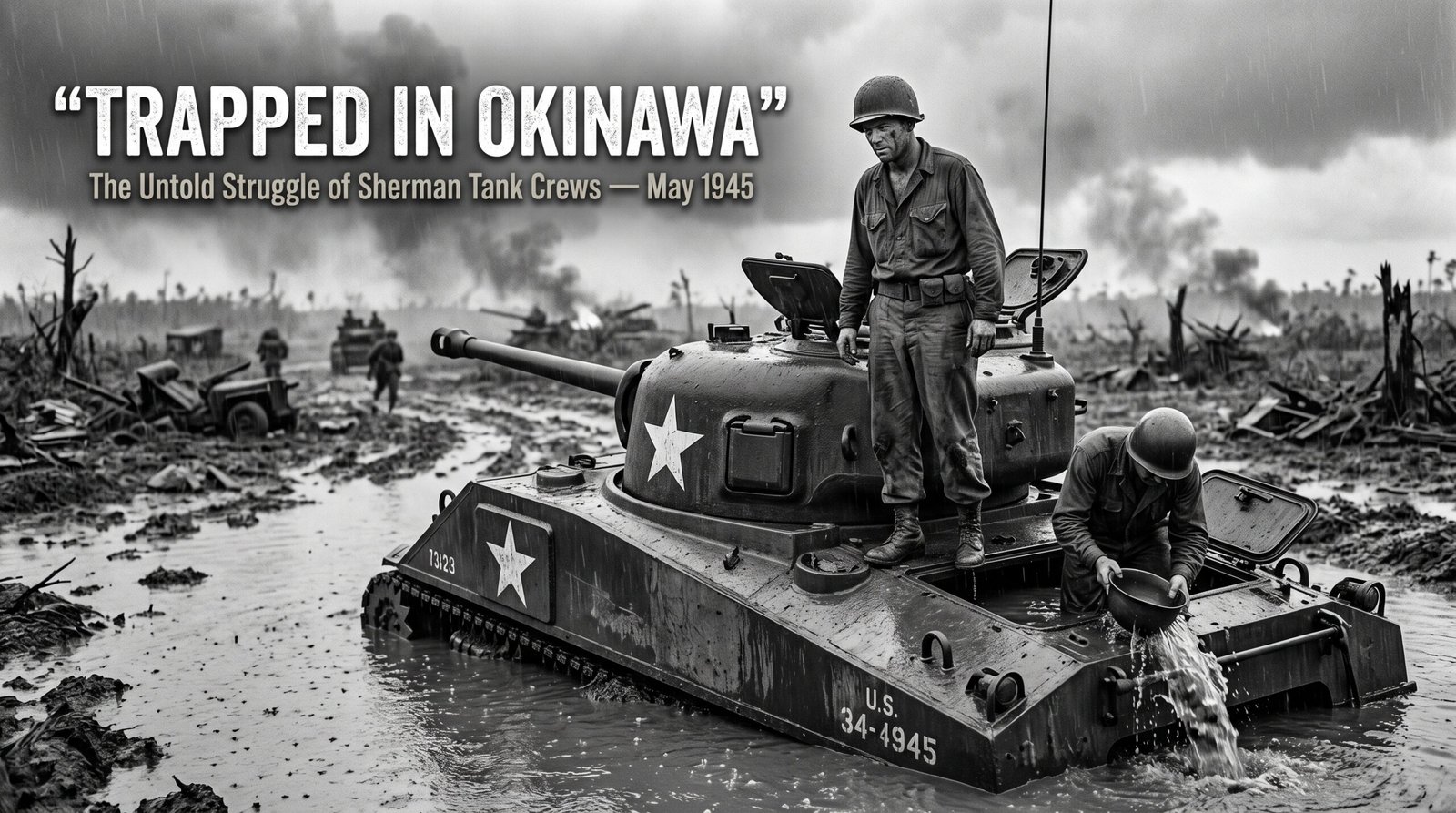
In one of the most famous photographs from the Pacific War, a stranded American Sherman tank sits half-submerged in muddy water on Okinawa. One crewman watches from the turret while another desperately scoops water out of the flooded vehicle using his helmet. The image captures more than a damaged tank — it captures the brutal reality of the Battle of Okinawa.
A Battle Fought in Rain, Mud, and Chaos
The photograph was taken during the Battle of Okinawa in May 1945, one of the bloodiest campaigns of the Second World War. American forces faced fierce Japanese resistance across difficult terrain filled with hills, caves, and heavily fortified defensive lines. Heavy seasonal rains transformed roads and fields into deep mud, making movement extremely difficult for tanks and supply vehicles.
The tank shown in the image was an M4 Sherman, the main American medium tank of the war. According to archival records, the vehicle became trapped in approximately five feet of water while crossing a stream in Okinawa. Recovery equipment had not yet arrived, leaving the crew stuck and vulnerable.
The Story Behind the Photograph
The original wartime caption described the scene with unusual honesty:
“A tank sunk in 5 feet of water waits for towing equipment. The Tank Commander gives vent to his feelings with a string of unprintable phraseology, while his driver uses a helmet to bail out the interior.”
The photograph was taken by Army photographer Alexander Roberts and later preserved in the U.S. National Archives.
What makes the image so powerful is its humanity. There is no dramatic explosion or battlefield charge. Instead, it shows exhaustion, frustration, and survival. The crew is not fighting enemy soldiers in that moment — they are fighting the environment itself.
Okinawa: The Most Difficult Pacific Campaign
The Battle of Okinawa lasted from April to June 1945 and became one of the deadliest battles of the Pacific Theater. American forces suffered enormous casualties, while Japanese military losses and civilian deaths were catastrophic. Tanks played a critical role in supporting infantry assaults, but Okinawa’s terrain often turned armored warfare into a nightmare.
Constant rain created flooded roads, mud-filled craters, and waterlogged fields. Sherman tanks regularly became stuck, disabled, or isolated. Japanese defenders also targeted tanks with mines, artillery, and hidden anti-tank positions.
For many tank crews, the danger did not only come from enemy fire. A disabled tank could become a death trap within seconds.
More Than Just a War Photo
This image remains iconic because it strips away romantic ideas about war. The men inside the Sherman were not posing as heroes. They were cold, soaked, exhausted, and stranded in hostile territory. The driver using his helmet to empty water from the tank became a symbol of the everyday struggle soldiers faced during World War II. Even with powerful machinery and advanced weapons, survival often depended on simple human effort.
Nearly eighty years later, the photograph still stands as a reminder that war was not only fought with bullets and explosions — it was also fought against fear, weather, exhaustion, and impossible conditions.