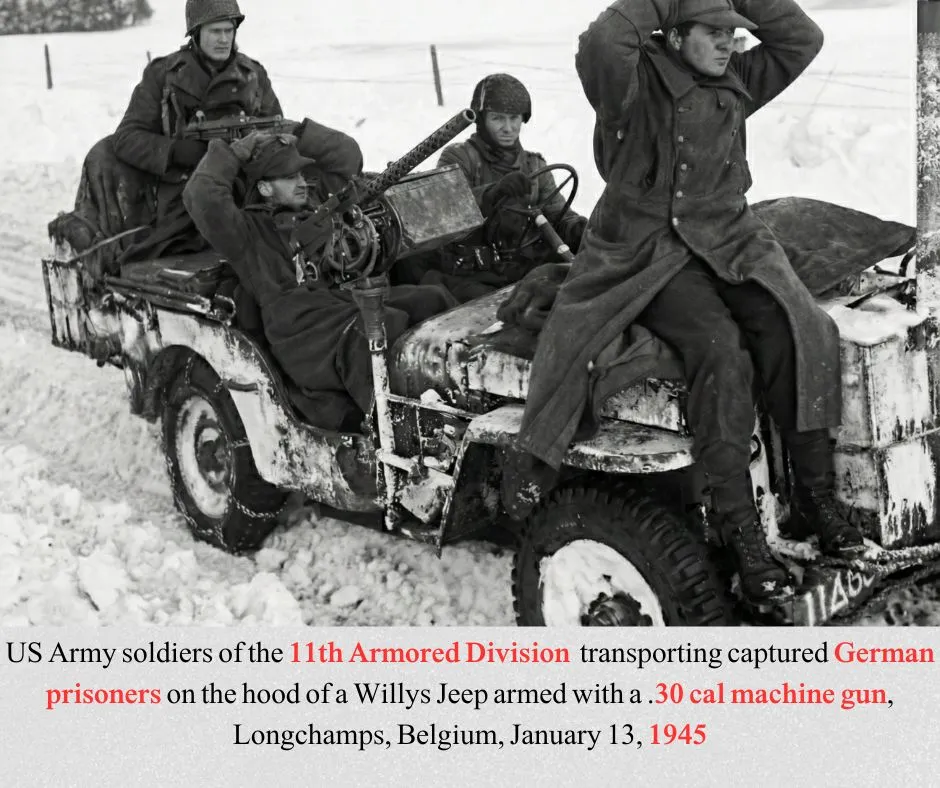
History is often captured not in the sweeping grand strategies of generals, but in the gritty, improvised moments of the soldiers on the ground. One such moment was immortalized on January 13, 1945, in the freezing terrain of Longchamps, Belgium. The photograph features US Army soldiers from the 11th Armored Division navigating the snow-covered Ardennes, transporting captured German prisoners of war (POWs) riding precariously on the hood of a Willys MB Jeep armed with a .30 caliber machine gun. To truly appreciate the image, we must look past the stark visual and examine the brutal reality of the Battle of the Bulge, the tactical necessity of the situation, and the sheer operational exhaustion of the men involved.
The Historical Context of the Ardennes Counter-Offensive
The Tail End of the Bulge
To understand the timeline of this photograph, one must look at the closing chapters of Germany’s last major offensive on the Western Front. Launched as a surprise blitzkrieg through the densely forested Ardennes region on December 16, 1944, the German assault had initially thrown Allied lines into chaos. In response, the 11th Armored Division, nicknamed the “Thunderbolts” and commanded by Major General Edward H. Brooks, was rushed to the front from France in late December to help contain the breakthrough. By January 13, 1945, the momentum had decisively shifted, and the Allied forces were aggressively pushing the German forces back, flattening the dangerous “bulge” in the line and capturing thousands of freezing, demoralized enemy troops.
The Brutal Winter Reality
The environment in which this photograph was taken was just as lethal as the enemy. The winter of 1944–1945 was one of the coldest on record in Western Europe, characterized by sub-zero temperatures, blinding blizzards, and waist-deep snow. For the men of the 11th Armored Division operating near Bastogne and Longchamps, every tactical movement was a grueling battle against frostbite, trench foot, and mechanical failure, making the efficient handling of combat operations a matter of literal survival.
Deconstructing the Vehicle and Armament
The Versatility of the Willys MB Jeep
The vehicle featured in the image is the legendary Willys MB Jeep, the ubiquitous, rugged workhorse of the Allied war effort. In the deeply snow-choked lanes of rural Belgium, heavy trucks often became bogged down, leaving the lightweight, four-wheel-drive Jeep as the primary lifeline for reconnaissance units, medical evacuation, and rapid transport. The specific vehicle in the photo reflects the standard field modifications of an advanced scouting or security element operating in highly volatile territory.
The .30 Caliber Defensive Perimeter
Mounted prominently on the Jeep is a Browning .30 caliber M1919A4 light machine gun, a weapon capable of delivering vital suppressive fire. In the dense woods surrounding Longchamps, where small pockets of German infantry frequently launched ambushes, having a mobile machine gun was essential for convoy survival. The placement of the weapon allowed the American crew to maintain a 360-degree defensive posture while moving through recently bypassed or contested enemy territory.
Tactical Reasons for Transporting POWs on the Hood
The Human Shield as a Deterrent
While placing enemy prisoners on the hood of a moving vehicle looks startling today, it was a highly practical, spontaneous tactical decision during the chaos of the Ardennes campaign. Allied troops advancing through the Belgian countryside faced constant harassment from hidden German snipers and isolated machine-gun nests. By placing captured German soldiers prominently on the front of the vehicle, the American GIs created an immediate visual deterrent; German holdouts waiting in the tree lines would think twice before pulling the trigger if it meant killing their own comrades.
Logistics, Space Constraints, and Human Survival
Beyond combat tactics, the decision was driven by severe logistical constraints and basic human survival. The Willys Jeep is a remarkably compact vehicle, and with a full combat crew, winter gear, rations, ammunition, and a pedestal-mounted machine gun, there was absolutely no room left inside the cabin. Furthermore, many of the captured German prisoners were suffering from severe frostbite and starvation due to the collapse of their own supply lines. Transporting them on foot through deep snowdrifts would require shedding valuable American manpower to act as walking guards, so utilizing the hood of the Jeep was the fastest, most efficient way to clear the combat zone and get the prisoners to the rear for proper interrogation and medical care.
The Lasting Legacy of the Thunderbolts
Closing the Houffalize Pocket
The actions of the 11th Armored Division around the date of this photograph were critical in securing the final Allied victory in the Ardennes. Just three days after this picture was taken, on January 16, 1945, the 11th Armored famously linked up with the 2nd Armored Division at Houffalize, Belgium. This historic link-up effectively cut off the tip of the German salient, trapping the remaining enemy forces and sealing the fate of the German offensive.
A Stark Window into Wartime Improvisation
Ultimately, the photograph from Longchamps serves as an enduring testament to the realities of World War II combat. It strips away the romanticism of war to reveal the raw, unvarnished truth of the Western Front: a world defined by bitter weather, rapid tactical improvisation, and the shared, exhausting misery of soldiers on both sides of the conflict.