Cryptocurrency is no longer just about trading and speculation. In 2025, more investors are turning to passive income strategies to grow their digital assets without constant monitoring. Instead of buying and selling daily, you can now earn steady rewards simply by holding and using your crypto in the right way.
For example, millions of investors are already staking assets like Ethereum, contributing to a growing ecosystem where users earn rewards through real blockchain activity—not just price movements.
In this guide, you’ll learn how to earn passive income with crypto, the best strategies to use, and the risks you should understand before getting started.

What Is Passive Income in Cryptocurrency?
Passive income in crypto means earning rewards from your digital assets without actively trading them. Instead of chasing market trends, you put your crypto to work through blockchain-based systems.
These earnings typically come from:
- Supporting blockchain networks
- Providing liquidity to markets
- Lending your assets to borrowers
- Participating in reward or incentive programs
However, while the income is “passive,” it’s not risk-free. Crypto markets are volatile, and technical risks like smart contract bugs or platform failures can impact your funds.
5 Best Ways to Earn Passive Income with Crypto
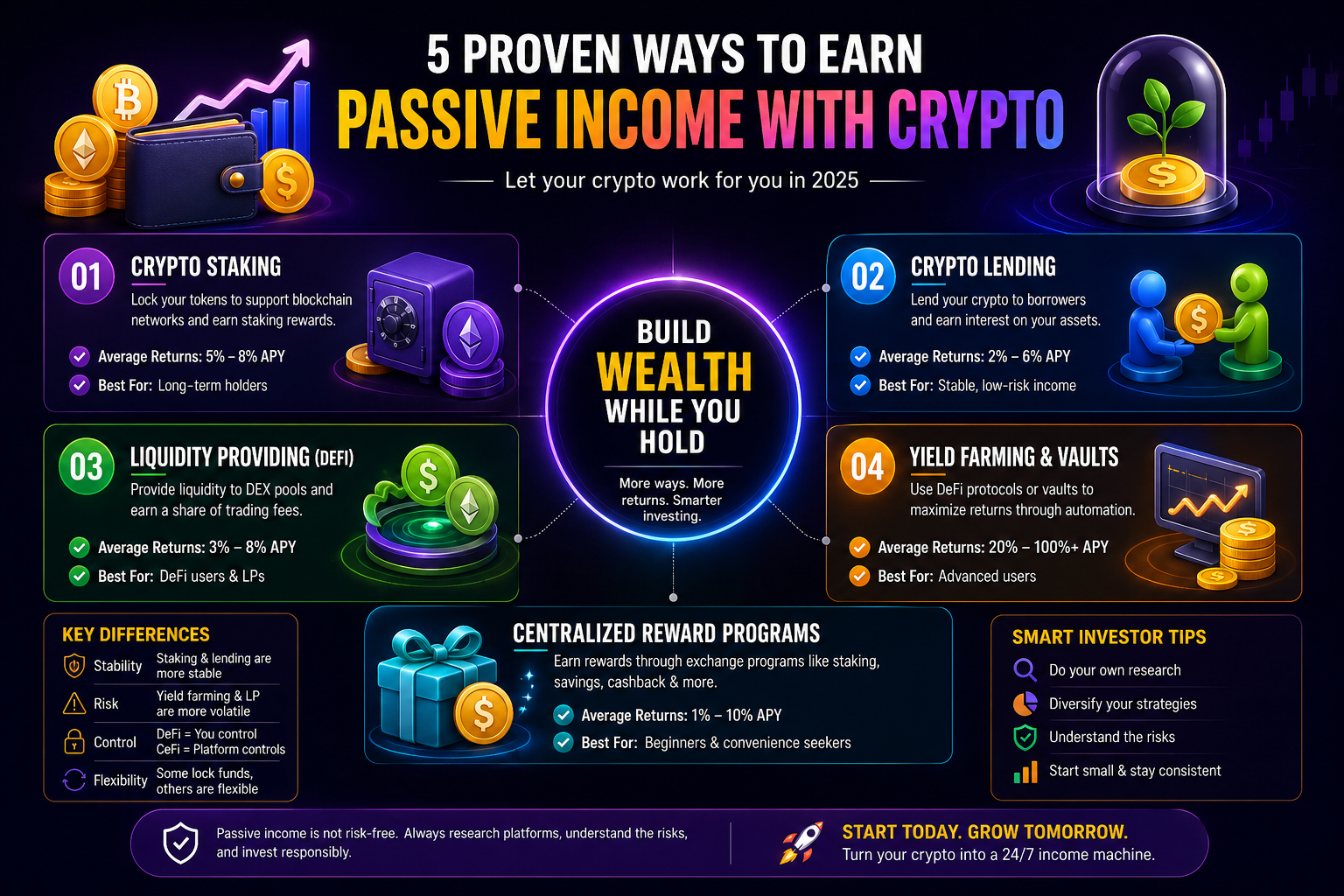
1. Crypto Staking
Staking is one of the most popular and beginner-friendly ways to earn passive income. It involves locking your cryptocurrency in a blockchain network to help validate transactions.
In return, you earn rewards—usually in the same cryptocurrency.
How it works:
You either run a validator or delegate your tokens to one. The network rewards you for helping maintain its security.
Average returns: Around 5%–8% annually (varies by network)
Advantages:
- Earn rewards on idle crypto
- Supports blockchain security
- Some platforms offer governance voting rights
Disadvantages:
- Token price fluctuations can reduce profits
- Lock-up periods may restrict access
- Regulations vary by country
2. Crypto Lending
Crypto lending allows you to earn interest by lending your assets to borrowers through centralized or decentralized platforms.
Borrowers pay interest, and you receive a portion of it as profit.
Typical returns: 2%–6% annually (especially for stablecoins)
Advantages:
- Simple and beginner-friendly
- Steady and predictable returns
- Wide range of supported assets
Disadvantages:
- Less transparency on centralized platforms
- Risk of account restrictions
- Security vulnerabilities in platforms
3. Liquidity Providing (DeFi)
Liquidity providers deposit crypto into pools on decentralized exchanges to facilitate trading. In return, they earn a share of transaction fees.
Estimated returns: 3%–8% APY (can vary widely)
Advantages:
- Earn trading fees passively
- Maintain control via non-custodial wallets
- Access to diverse crypto pairs
Disadvantages:
- Risk of impermanent loss
- Market volatility affects returns
- Exposure to scams or fake projects
4. Yield Farming & Vault Strategies
Yield farming involves moving your crypto between DeFi platforms to maximize returns. It’s more advanced but can offer higher rewards.
Vault strategies automate this process, optimizing returns without manual effort.
Potential returns: Can exceed 50%+ APY in some cases (high risk)
Advantages:
- High earning potential
- Access to new tokens and incentives
- Automation reduces effort (via vaults)
Disadvantages:
- High risk of loss
- Smart contract vulnerabilities
- Complex for beginners
5. Centralized Crypto Reward Programs
Crypto exchanges offer built-in earning programs such as staking rewards, cashback, and interest accounts.
These are ideal for beginners who want a simple way to earn passive income.
Advantages:
- Easy to use
- Strong security features (like 2FA)
- Supports fiat and crypto
Disadvantages:
- Funds controlled by the platform
- Limited transparency
- Possible account restrictions
Key Differences Between Passive Income Methods
Understanding how these strategies differ helps you choose the right one:
- Stability: Staking and stablecoin lending are more consistent
- Risk Level: Yield farming and liquidity pools are more volatile
- Control: DeFi gives you full control; centralized platforms do not
- Flexibility: Some methods lock your funds, while others allow instant withdrawal
Which Crypto Passive Income Strategy Is Best?
There’s no one-size-fits-all answer. The best strategy depends on your goals and risk tolerance.
- If you prefer stability → Try staking or lending
- If you want higher returns → Explore yield farming
- If you’re a beginner → Start with centralized programs
Instead of chasing high APYs, focus on:
- How the platform generates returns
- Whether you can withdraw funds easily
- The risks involved
Final Thoughts
Earning passive income with crypto in 2025 is more accessible than ever. Whether you choose staking, lending, or DeFi strategies, the key is understanding how each method works and managing your risk carefully.
Start small, diversify your strategies, and always research platforms before investing.
FAQ
How can beginners earn money with crypto?
Beginners often start with staking or holding major cryptocurrencies because these methods are simple and relatively stable.
What is the best way to earn passive income in crypto?
Staking and lending are considered the safest starting points, while advanced users may prefer yield farming.
Is passive income from crypto real?
Yes, many platforms offer real rewards for participating in blockchain networks or lending markets.
Is crypto a safe investment?
Crypto can be profitable but is highly volatile. Always invest responsibly and consider professional advice.