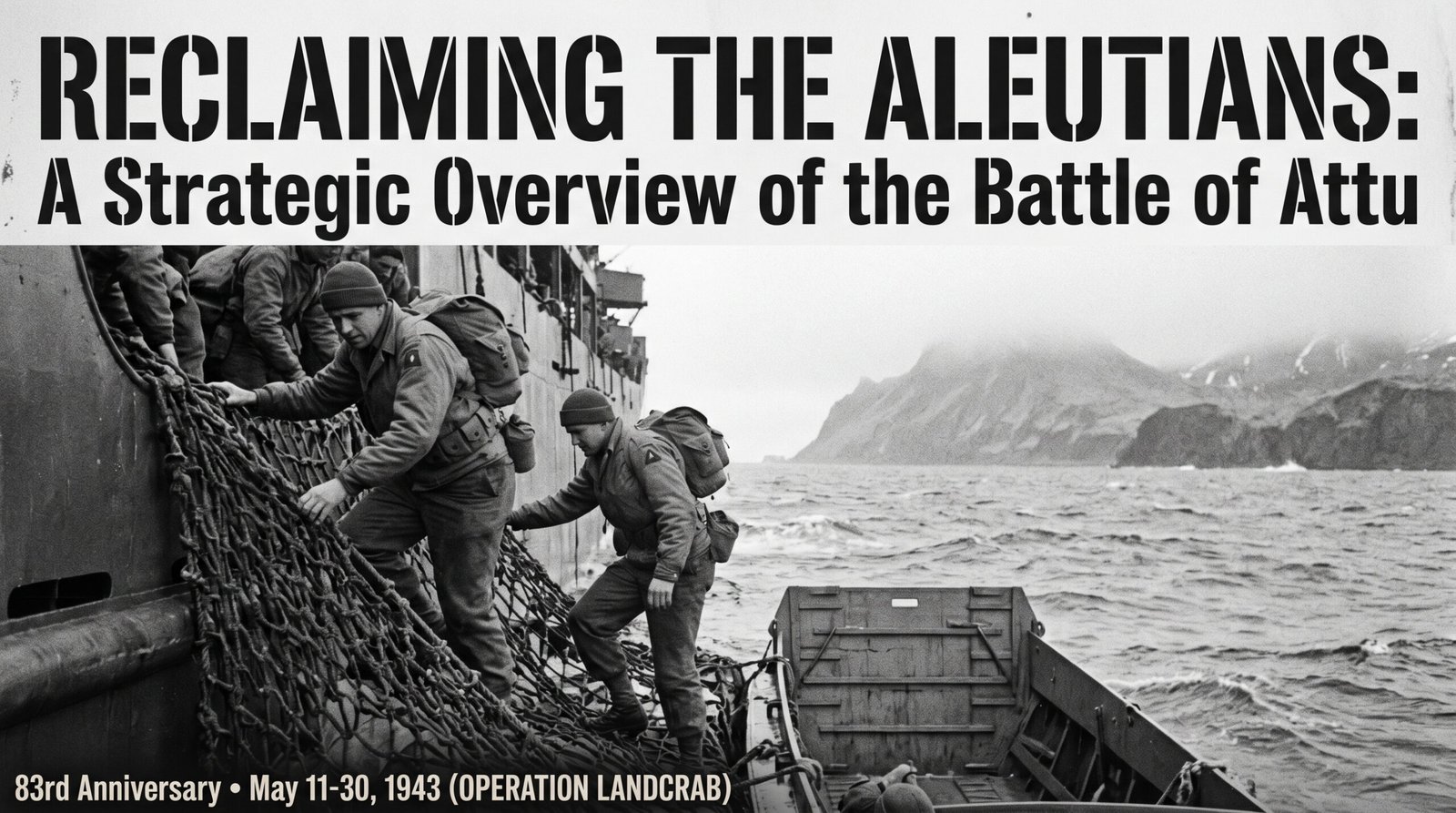
The Battle of Attu, conducted between May 11 and May 30, 1943, stands as a singular event in the American theater of World War II. Codenamed Operation Landcrab, this mission was the primary effort to expel Japanese forces from the Aleutian Islands. It remains the only land battle of the war fought on incorporated United States territory. For the 7th Infantry Division, the mission was not merely a tactical maneuver against an entrenched enemy, but a desperate struggle for survival against some of the most inhospitable environmental conditions on Earth.
The Strategic Value of the Northern Front
While the world’s attention was largely focused on the South Pacific and Europe, the Japanese occupation of Attu and Kiska in June 1942 represented a significant breach of North American security. The islands served as a strategic “anchor” in the North Pacific, offering the Japanese Empire a vantage point to monitor U.S. naval movements and a potential platform for aerial strikes against the West Coast. Reclaiming Attu was essential to restoring American sovereignty and securing the Great Circle shipping routes that connected North America to the Soviet Union.
The Environmental Challenge: Combat in the Subarctic
The American forces, many of whom had been trained for desert warfare, were ill-prepared for the “williwaws” (violent mountain winds) and the treacherous “muskeg” of Attu. This bog-like tundra made the movement of heavy machinery nearly impossible, forcing soldiers to manually haul supplies, ammunition, and artillery up jagged volcanic slopes. The climate proved to be as lethal as the enemy; damp, freezing conditions led to over 1,200 casualties related to exposure, trench foot, and frostbite. This high rate of non-combat injury highlights the immense logistical difficulty of conducting amphibious assaults in subarctic conditions without specialized cold-weather gear.
Defensive Entrenchment and Tactical Evolution
Unlike the beach-head defenses seen in other Pacific campaigns, the Japanese defenders, under Colonel Yasuyo Yamasaki, withdrew to the high ground overlooking the landing zones. This “interior defense” strategy utilized the island’s natural fog and caves to neutralize the impact of U.S. naval and aerial bombardment. The fighting transitioned into a grueling series of mountain engagements, where American troops had to clear spider holes and ridge-line bunkers one by one. It was in this environment that Pfc. Joseph P. Martinez displayed the gallantry that earned him a posthumous Medal of Honor, leading a charge that broke a critical enemy bottleneck on May 26.
The Banzai Charge and the Final Collapse
The battle reached its harrowing conclusion on May 29, 1943. With their supplies exhausted and no hope of reinforcement, the remaining Japanese forces launched one of the largest and most desperate banzai charges of the Pacific war. This final, frantic surge bypassed American front-line units, leading to chaotic hand-to-hand combat in rear-echelon medical and command posts. When the fog lifted the following morning, organized Japanese resistance had effectively ceased. The cost of victory was steep: 549 American lives were lost, while nearly the entire Japanese garrison of over 2,300 men perished, leaving only 28 survivors to be taken as prisoners of war.
Historical Legacy of Operation Landcrab
The victory at Attu had immediate strategic repercussions, causing the Japanese to secretly evacuate their remaining forces from the neighboring island of Kiska under the cover of fog. Today, the Battle of Attu serves as a critical case study in military history for its lessons on cold-weather operations and the endurance of the individual infantryman. As we mark this 83rd anniversary, the campaign remains a testament to the sheer resilience required to fight—and win—on the very edge of the American frontier.