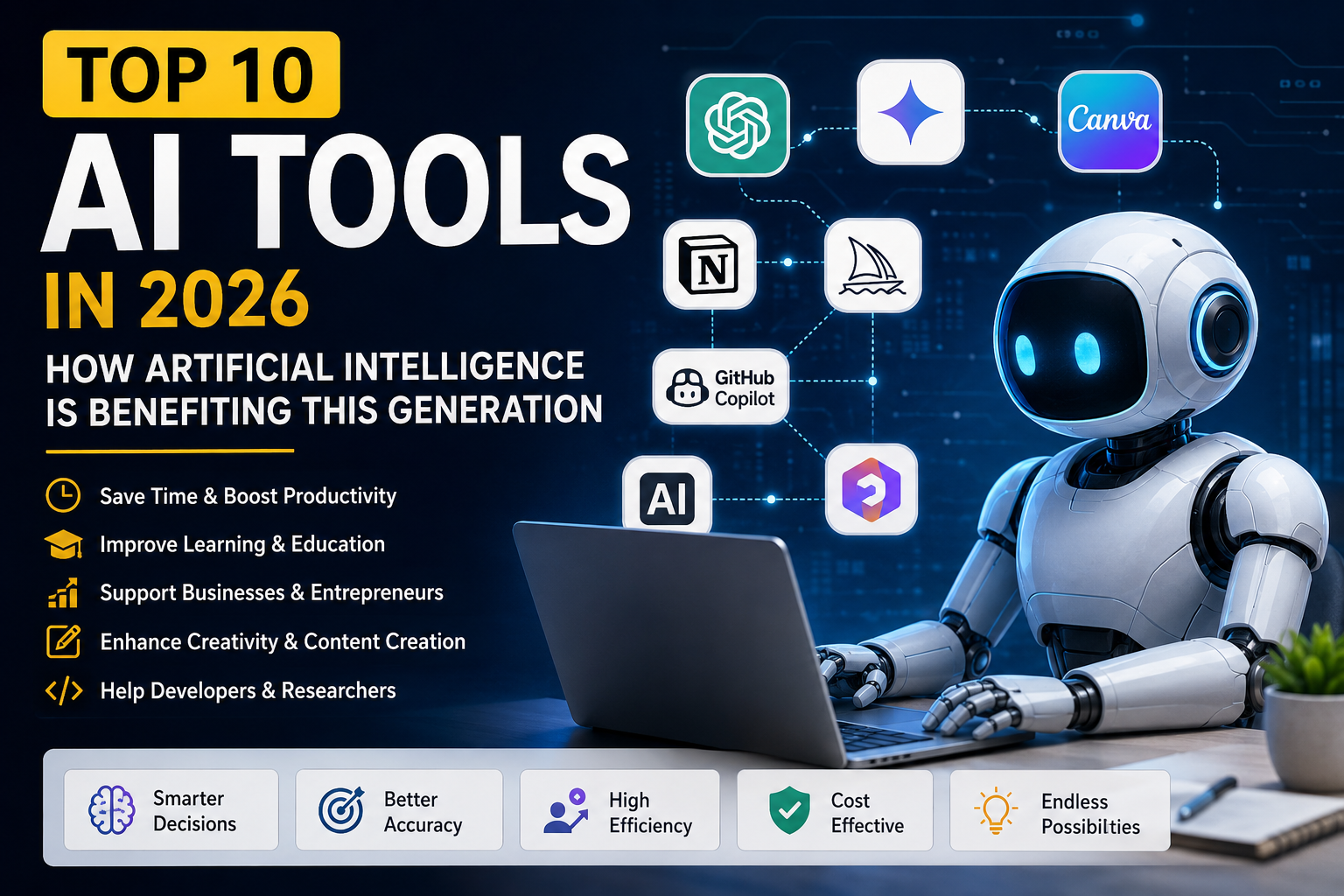
Top 10 AI Tools in 2026: How Artificial Intelligence Is Benefiting This Generation
Artificial intelligence (AI) has quickly become one of the most important technologies of the modern era. What once seemed like science fiction is now part of everyday life. People use AI to write emails, create images, analyze information, learn new skills, write computer code, conduct research, edit videos, automate business tasks, and even generate ideas.
The rise of AI tools is changing the way students, employees, entrepreneurs, content creators, developers, and businesses work. Instead of replacing every human task, AI is increasingly being used as an assistant that helps people complete work faster and explore possibilities that were previously difficult or expensive.
According to Stanford’s 2025 AI Index, 78% of organizations reported using AI in 2024, compared with 55% in 2023. The same report found strong evidence of productivity improvements associated with AI adoption. More recent research also shows that generative AI adoption continues to expand rapidly, making AI tools an increasingly important part of modern digital life.
This article explains how AI tools benefit the current generation and explores the top 10 AI tools in 2026 that can help with productivity, education, business, research, design, coding, and content creation.
What Are AI Tools?
AI tools are software applications or online platforms that use artificial intelligence to perform tasks that traditionally require human intelligence.
Depending on the tool, artificial intelligence can understand text, recognize images, generate content, analyze data, write code, summarize documents, answer questions, translate languages, create designs, generate audio and video, and automate repetitive processes.
Modern generative AI tools are particularly powerful because users can interact with them using ordinary language. Instead of learning complicated software commands, a person can simply describe what they want.
For example, a student might ask an AI tool to explain a difficult scientific concept. A business owner can ask AI to create a marketing plan. A developer can use AI to identify a programming error. A content creator can generate ideas, scripts, images, or video concepts.
This accessibility is one of the major reasons AI has spread so quickly.
Why Are AI Tools Important in This Generation?
The current generation is growing up in a digital environment where information, communication, education, and business are increasingly connected to technology.
AI adds another layer to this digital transformation by allowing computers to understand and generate information in increasingly useful ways.
Research from Stanford’s 2026 AI Index indicates that generative AI reached 53% adoption within three years, faster than the personal computer or the internet reached comparable adoption milestones.
The importance of AI can be understood through several major benefits.
1. AI Saves Time
One of the biggest advantages of AI tools is their ability to reduce the amount of time required to complete repetitive or information-heavy tasks.
For example, instead of spending an hour creating a first draft of an email, report, article, or presentation, a person can use AI to produce an initial version within minutes.
AI can also summarize long documents, organize information, generate lists, analyze data, and help users find patterns.
Research from OpenAI’s 2025 enterprise report found that 75% of surveyed workers said AI improved either the speed or quality of their work.
The important point is that saving time does not necessarily mean doing less work. It can allow people to spend more time on creative thinking, decision-making, communication, and other tasks that require human judgment.
2. AI Improves Productivity
Productivity is another major reason businesses and individuals are adopting AI.
A worker who normally spends several hours researching, drafting, editing, and organizing information may be able to complete the same workflow much faster with the help of AI.
For example, a digital marketer can use AI to brainstorm campaign ideas, create initial copy, analyze customer feedback, and organize content ideas.
Similarly, a programmer can use AI to explain code, generate functions, find potential bugs, and create documentation.
Research from the Federal Reserve Bank of St. Louis estimated that generative AI could have contributed to meaningful productivity gains, while noting that the exact effect depends on how workers and organizations use the technology.
AI therefore has the potential to become a productivity multiplier rather than simply another software application.
3. AI Makes Learning Easier
Education is one of the areas where AI can have a particularly significant impact.
Students can use AI tools as personal learning assistants. They can ask questions, request explanations at different difficulty levels, generate practice questions, summarize concepts, and receive help understanding complicated subjects.
For example, a student struggling with mathematics could ask an AI tool to explain a problem step by step. Someone learning English could practice conversations with an AI assistant.
However, students should use AI as a learning aid rather than simply copying AI-generated answers. The goal should be understanding the subject, checking information, and developing independent thinking skills.
Used responsibly, AI can make personalized learning much more accessible.
4. AI Helps Small Businesses
AI is not only useful for large corporations. Small businesses and individual entrepreneurs can also benefit.
A small business may not have enough money to hire separate specialists for marketing, graphic design, customer support, research, copywriting, and data analysis.
AI tools can assist with many of these activities.
For example, a small online store can use AI to:
- Create product descriptions
- Generate social media ideas
- Draft customer emails
- Analyze reviews
- Create marketing concepts
- Prepare frequently asked questions
- Brainstorm new products
- Organize business information
This can reduce the amount of time required to perform routine tasks and allow small teams to compete more effectively.
5. AI Supports Content Creators
The creator economy has also been transformed by AI.
Bloggers, YouTubers, social media creators, designers, and marketers can use AI during almost every stage of content production.
AI can help generate:
- Blog ideas
- Video scripts
- Headlines
- Social media captions
- Images
- Voiceovers
- Video concepts
- Content calendars
- SEO outlines
The best results usually come when humans remain responsible for the creative direction, facts, storytelling, and final editing.
AI can accelerate production, but human creativity is still extremely important.
6. AI Helps Programmers and Developers
Software development is another field where AI tools have become increasingly useful.
AI coding assistants can explain unfamiliar code, suggest functions, generate boilerplate code, identify possible errors, and help developers understand technical documentation.
This is particularly useful for beginners because they can ask questions in natural language rather than searching through dozens of technical pages.
At the same time, developers should review AI-generated code carefully. AI can produce incorrect, insecure, inefficient, or outdated solutions.
AI should therefore be treated as a programming assistant rather than an unquestionable authority.
7. AI Makes Research Faster
Research often involves reading large amounts of information and identifying the most relevant points.
AI-powered research tools can help users summarize information, compare sources, generate questions, organize notes, and identify important topics.
This can be especially useful for students, journalists, researchers, entrepreneurs, and professionals.
However, AI-generated information should always be verified when accuracy matters. AI systems can sometimes produce incorrect information or misunderstand the context of a source.
8. AI Helps With Creativity and Design
Previously, creating professional-looking graphics often required specialized software skills.
Modern AI design tools have made visual creation much easier.
Users can describe an image or design in natural language and receive a generated result. AI can also help remove backgrounds, create layouts, generate presentations, edit images, and produce marketing materials.
This does not eliminate the need for designers. Instead, it gives more people access to creative tools and allows professional designers to experiment more quickly.
Top 10 AI Tools in 2026
There are thousands of AI applications available today, and no single tool is best for every task. The following list focuses on widely useful tools across productivity, research, writing, design, coding, and content creation.
1. ChatGPT
ChatGPT is one of the most versatile AI tools available today.
It can assist with writing, brainstorming, research, coding, learning, analysis, planning, summarization, and many other tasks.
Students can use it to understand difficult concepts. Writers can use it for brainstorming and editing. Developers can use it to analyze code. Business owners can use it to generate ideas and organize information.
The biggest advantage of a general-purpose AI assistant is flexibility. Instead of using a separate application for every small task, users can perform many workflows through one conversational interface.
Best for: Writing, learning, brainstorming, coding, research, productivity, and general assistance.
2. Google Gemini
Google Gemini is Google’s family of generative AI tools.
Gemini is particularly useful for people who already rely heavily on Google’s ecosystem. Depending on the available features and plan, it can assist with writing, research, brainstorming, document-related tasks, image understanding, and other forms of productivity.
Its connection with Google’s broader ecosystem can make it useful for users who already work with Google services.
Best for: Google users, research, productivity, writing, and multimodal AI tasks.
3. Claude
Claude is an AI assistant developed by Anthropic.
It is known for strong performance in writing, reasoning, document analysis, and coding-related tasks. It can be useful when users need to work with long pieces of text or develop detailed written material.
For professionals, Claude can be useful for reviewing documents, brainstorming, writing, summarizing, and analyzing complex information.
Best for: Writing, long documents, reasoning, analysis, and coding.
4. Microsoft Copilot
Microsoft Copilot brings AI assistance into Microsoft’s productivity ecosystem.
For people who use Microsoft products for work, AI assistance can be especially valuable because productivity tasks often involve documents, spreadsheets, presentations, email, and collaboration.
Instead of switching constantly between different applications, users can increasingly incorporate AI into existing workflows.
Best for: Microsoft users, business productivity, documents, presentations, and workplace tasks.
5. Perplexity
Perplexity focuses heavily on AI-powered search and research.
Instead of simply returning a traditional list of search results, it aims to provide direct answers supported by sources.
This makes it useful when someone wants to explore a topic quickly and identify relevant information.
Perplexity can be particularly helpful for researchers, students, journalists, and professionals who need to investigate topics online.
Best for: Research, information discovery, and source-based answers.
6. Canva AI
Canva has become a popular platform for creating graphics, presentations, social media designs, and marketing materials.
Its AI features make the design process easier by allowing users to generate or modify content using natural-language instructions.
Someone without professional graphic-design experience can use Canva to create social media posts, presentations, posters, thumbnails, and other visual materials.
Best for: Graphic design, social media content, presentations, and marketing.
7. GitHub Copilot
GitHub Copilot is designed specifically to help software developers.
It can provide coding suggestions, generate code, explain programming concepts, and assist with development workflows.
For experienced developers, it can reduce repetitive coding work. For beginners, it can serve as a learning assistant when used responsibly.
However, programmers should always test and review generated code before using it in production.
Best for: Software development, programming, debugging assistance, and code generation.
8. ElevenLabs
ElevenLabs focuses on AI-generated and AI-assisted audio.
It can be useful for voiceovers, narration, content production, accessibility, and other audio applications.
For video creators, this can significantly simplify the process of creating narration without requiring professional recording equipment.
Creators should still pay attention to voice rights, consent, licensing, and platform policies when using synthetic voices.
Best for: AI voice generation, narration, voiceovers, and audio content.
9. Suno
Suno is an AI music-generation platform that allows users to create music using text-based descriptions.
It can be useful for experimenting with music ideas, creating background tracks, exploring songwriting concepts, and producing creative audio projects.
As with other generative AI platforms, users should understand the platform’s current terms and commercial-use rules before using generated music for monetized projects.
Best for: Music creation, songwriting experiments, and creative audio.
10. NotebookLM
NotebookLM is designed around working with user-provided sources and documents.
It can be particularly useful for students, researchers, and professionals who need to understand a collection of information.
Instead of asking a general AI about a topic, users can provide relevant source material and use AI to help summarize, organize, and explore that material.
Best for: Studying, research, document analysis, and source-based learning.
AI Tools Comparison
| AI Tool | Best Use | Ideal Users |
| ChatGPT | General AI assistance | Students, professionals, creators |
| Google Gemini | Google-connected productivity | Students and professionals |
| Claude | Writing and reasoning | Writers, researchers, developers |
| Microsoft Copilot | Workplace productivity | Businesses and employees |
| Perplexity | AI research | Researchers and students |
| Canva AI | Design and visual content | Creators and marketers |
| GitHub Copilot | Coding | Developers |
| ElevenLabs | Voice generation | Video and audio creators |
| Suno | Music generation | Musicians and creators |
| NotebookLM | Source-based research | Students and researchers |
How AI Is Changing the Future of Work
AI is not simply creating new software products. It is changing how people approach work.
In the past, employees often needed to learn specialized software before they could perform certain tasks. Modern AI increasingly allows users to communicate with technology through natural language.
This lowers the barrier to using advanced technology.
For example, a person who has never studied programming can use an AI assistant to understand basic code. A small-business owner without a marketing team can brainstorm campaigns. A student can receive personalized explanations.
However, AI also creates new challenges.
Workers need to learn how to evaluate AI-generated information. Businesses need policies for privacy and responsible use. Students need to understand academic integrity. Developers need to consider security when using AI-generated code.
The future will therefore not simply be about knowing how to use AI. It will be about knowing when to use AI, how to use it effectively, and when human judgment should take priority.
Limitations of AI Tools
Although AI offers many benefits, it is not perfect.
AI Can Make Mistakes
AI systems can generate incorrect information. Users should verify important facts rather than assuming every AI response is accurate.
Privacy Matters
Users should avoid entering sensitive personal, financial, business, or confidential information into AI tools unless they understand how that information is handled.
AI Can Create Bias
AI systems learn from data and can sometimes reproduce biases or produce unfair results.
Human Creativity Still Matters
AI can generate ideas, but human experience, emotions, judgment, originality, and cultural understanding remain extremely important.
Overdependence Can Be a Problem
If people allow AI to do everything for them, they may stop developing important skills.
The best approach is to use AI as an assistant while continuing to develop independent knowledge and critical thinking.
How to Use AI Tools Effectively
Getting good results from AI requires more than simply asking random questions.
Users should provide clear instructions and enough context.
For example, instead of asking:
“Write an article about business.”
A better prompt would be:
“Write a 1,500-word beginner-friendly article about starting an online business in Pakistan. Use clear headings, practical examples, an SEO-friendly structure, and a professional but conversational tone.”
The second prompt gives the AI a clear objective, audience, length, topic, and style.
Users should also review AI-generated content, verify important claims, and add their own experience and perspective.
Are AI Tools Going to Replace Humans?
This is one of the biggest questions surrounding artificial intelligence.
The answer is more complicated than simply saying yes or no.
AI will automate some tasks, change certain jobs, and create new types of work. At the same time, many people will use AI as a tool to become more productive.
Recent research suggests that AI adoption is producing both productivity opportunities and workforce challenges. Stanford’s 2026 AI Index reports that organizational adoption continued to rise, while also highlighting uneven labor-market effects and uncertainty around future employment.
This means the most valuable skill may not be competing against AI, but learning how to work effectively with it.
A person who understands their profession and knows how to use AI effectively may have an advantage over someone who ignores the technology.
The Future of AI Tools
AI tools are likely to become more capable, affordable, and integrated into everyday software.
Stanford’s AI Index has documented rapid improvements in AI performance alongside major reductions in the cost of using advanced models.
This trend could make sophisticated AI capabilities available to more individuals and smaller businesses.
The next stage may involve AI agents that can complete multi-step tasks rather than simply answering individual questions. Businesses are already experimenting with these systems, although widespread autonomous deployment remains relatively early.
AI may eventually become less visible as a separate tool and more like an underlying assistant integrated into the applications people already use.
Final Thoughts
Artificial intelligence is one of the defining technologies of this generation. From education and business to programming, design, research, entertainment, and content creation, AI tools are changing how people work and learn.
The biggest benefit of AI is not simply that it can produce text, images, code, or audio. Its real value comes from helping people move from an idea to a result more quickly.
Tools such as ChatGPT, Gemini, Claude, Microsoft Copilot, Perplexity, Canva AI, GitHub Copilot, ElevenLabs, Suno, and NotebookLM demonstrate how broad the modern AI ecosystem has become.
However, using AI successfully requires balance. People should use AI to save time and expand their capabilities while continuing to think critically, verify information, protect privacy, and develop their own skills.
The future will likely belong not to people who completely depend on AI, but to people who understand how to combine human creativity, judgment, experience, and artificial intelligence.
As AI continues to develop, learning how to use these tools effectively is no longer just a technological advantage. For many students, professionals, creators, and businesses, it is becoming an essential digital skill.